Stone Guide
What Is Moissanite? A Simple Guide to the Stone
A straightforward introduction to moissanite, its distinctive light, everyday care, and what to consider when choosing a piece.
.png&w=3840&q=75)
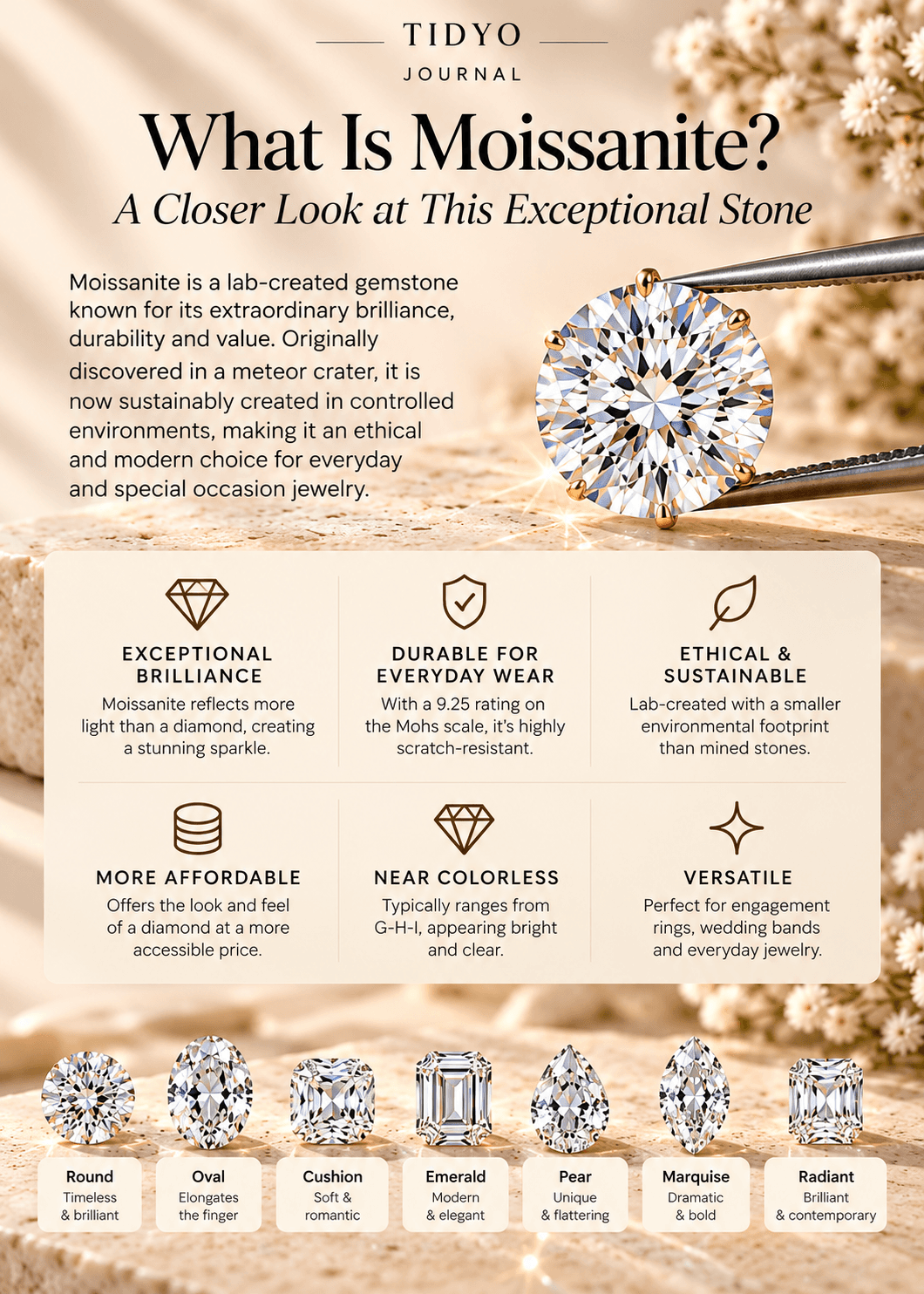
Moissanite is a gemstone made from silicon carbide, valued in jewelry for its brightness and lively flashes of color. Natural moissanite is exceptionally rare; the stones used in modern jewelry are generally created in controlled laboratory conditions. That origin is part of its identity, not an imitation of how another stone is formed.
It is often discussed beside diamond because both can be transparent, faceted, and highly reflective. They are different materials with different optical character. Understanding that distinction makes it easier to choose moissanite for what it is: a bright, durable jewelry stone with a look of its own.
Where moissanite comes from
Silicon carbide associated with moissanite was identified in material from a meteorite crater in the late nineteenth century. Naturally occurring crystals are too scarce and typically too small for broad use in jewelry. Laboratory-grown material made modern moissanite jewelry possible by producing crystals suitable for cutting and setting.
“Lab created” describes the origin of the crystal; it does not mean the stone is plastic or glass. A finished moissanite is cut and polished to interact with light, then set into jewelry in much the same practical manner as other faceted stones.
What moissanite looks like
Moissanite is known for strong brilliance and fire. Brilliance refers to white light returned from a stone, while fire describes flashes of spectral color. Depending on the cut, lighting, and stone size, moissanite can show pronounced rainbow flashes. Some people enjoy that vivid effect; others prefer a quieter appearance. Neither preference is more correct.
Cut has a major influence on the result. Round and halo arrangements can emphasize sparkle, while other silhouettes distribute light differently. The Stellar Halo Moissanite Ring uses surrounding detail to create an especially luminous composition. Colored stones, such as the Blue Butterfly Moissanite Ring, add another visual dimension beyond the familiar colorless look.
Is moissanite a diamond?
No. Diamond is carbon; moissanite is silicon carbide. They have different crystal structures, optical properties, and market histories. Moissanite should be described accurately by its own name rather than presented as a diamond. Visual similarity in certain settings does not make the materials interchangeable.
This distinction also helps when comparing price. A moissanite piece may offer a larger or more light-catching look at a different price point, but value depends on the entire item: stone quality, cut, setting, metal, finish, design, and craftsmanship all contribute.
How durable is moissanite?
Moissanite is considered a hard gemstone and is commonly used in jewelry intended for regular wear. Hardness describes resistance to scratching; it does not mean a stone or setting is impossible to chip, loosen, or damage. Impact, pressure, and wear to prongs can affect any piece. The surrounding metal and construction matter just as much as the center stone.
For a ring, remove the piece before heavy lifting, cleaning, gardening, or activities that may strike the setting. Browse moissanite and statement rings with both the stone and the silhouette in mind. A low-profile setting may feel different in daily use from a raised halo or sculptural design.
How to care for moissanite jewelry
Oils, lotion, soap, and cosmetics can leave residue that makes a bright stone appear duller. Put jewelry on after personal care products have dried, and wipe it gently after wear. Follow the care guidance for the complete piece, particularly if it has plating, additional stones, or delicate settings.
- Store the piece separately to reduce friction with other jewelry.
- Avoid harsh household chemicals and abrasive cleaning products.
- Check settings periodically and stop wearing the piece if a stone feels loose.
- Use professional cleaning advice when the metal, plating, or setting needs special care.
Earrings and necklaces encounter different kinds of wear than rings. The Twisted Infinity Halo Moissanite Earrings avoid the constant hand contact of a ring, while the Celestial Arc Moissanite Necklace should be stored so its chain and setting do not tangle with other pieces.
What to consider before choosing
Look at the stone in context
Consider scale, cut, color, setting height, and the metal around it. A stone that feels subtle in stud earrings may feel more pronounced in a ring. Product photography in more than one angle can help show proportion, though lighting will always influence sparkle.
Choose the optical character you enjoy
Moissanite’s colorful fire is a feature, not a defect. If you enjoy energetic sparkle, it may suit you beautifully. If you prefer softer light, consider a smaller stone, a different cut, or a design where moissanite acts as an accent rather than the entire focal point.
A stone with its own point of view
Moissanite is not best understood as a substitute. It is a laboratory-created jewelry stone with distinctive brilliance, strong fire, and practical hardness. Choosing it is ultimately about whether that visual energy and the complete design fit your style.
Explore the necklace collection or the current ring and earring edits to find moissanite used as both a refined accent and a clear focal point.